
This cartoon is by RJ Matson, of Roll Call (I believe subscription is required).
Also check out Ed Morrissey's worthwhile read of the Democrats' latest proposal for getting out of Iraq: 'Withdrawal 2; Electric Boogaloo.'
Back to the top.
Tuesday, June 20, 2006
Dems Chart Course on Iraq

Monday, June 19, 2006
Murtha vs. Irey
John Murtha's willingness to step to the forefront to say silly things about redeployment of US forces has led to more attention to his challenger in November. AllahPundit and Instapundit for example, have taken note.
Anyway, thought I'd post what little National Journal (subscription required) has to say about the race. They rate the district as 'solidly democratic,' and add:
District Profile: Although it was carefully carved by Democratic redistricting, the 12th District saw John Kerry squeak by only two points ahead of George W. Bush.
2004 Results: John Murtha (D) was unopposed
That's not much to go on, but the 'solidly democratic' assessment probably reflects Murtha's long tenure, previous non-controversiality, and the expectation that Republicans would not seriously contest the race. Changed circumstances might lead National Journal to reassess.
NJ also gives a very lenghty profile of Murtha and the district, but little of it is relates directly to the politics of the race:
...The 12th Congressional District of Pennsylvania, with highly irregular boundaries, contains much of this coal and steel country. It includes all of Greene County and parts of Fayette, Somerset, Cambria, Indiana, Armstrong, Washington and Westmoreland Counties. The boundaries were drawn by Republican legislators who wanted to create a new Republican-leaning 18th District in the southern suburbs of Pittsburgh while also accommodating Democratic Congressman John Murtha, second ranking minority member on the Appropriations Committee, who has worked assiduously to help Pennsylvania. The district includes Murtha's home base of Johnstown and Democratic territory in the southwestern corner of the state.
Politically, this was one of the most Republican parts of America from the Civil War up to the 1930s. Republican policies, including high tariffs and hostility to labor unions, were seen as protecting jobs and increasing growth in the steel economy centered on Pittsburgh. With the coming of the New Deal, and success of the United Mine Workers and the United Steelworkers, the area began voting mostly Democratic. Since 1945, on the Monday before primary and general elections, Democratic pols from across southwestern Pennsylvania have attended the "rally in the valley" held at the Slovak Home in the mill town of Monessen. But it has not followed the national Democratic Party on all issues. Voters here have strongly favored trade restrictions on steel imports, even when most other Democrats were free traders in the 1960s and 1970s; more recently most House Democrats have been opposing free trade measures. Voters here also tend to take conservative stands on cultural issues and foreign policy. This carefully carved district voted 55%-44% for Al Gore in 2000. But after George W. Bush imposed import quotas on steel and boosted clean coal technology, the district voted only 51%-49% for John Kerry...
Candidate Total Votes Percent Expenditures
2004 general John Murtha (D) unopposed
2004 primary John Murtha (D) unopposed
2002 general
John Murtha (D) 124,201 73% $2,386,861
Bill Choby (R) 44,818 27% $17,584
Prior winning percentages: 2000 (71%); 1998 (68%); 1996 (70%); 1994 (69%); 1992 (100%); 1990 (62%); 1988 (100%); 1986 (67%); 1984 (69%); 1982 (61%); 1980 (59%); 1978 (69%); 1976 (68%); 1974 (58%); 1974 (50%)
2004 Presidential Vote
Kerry (D) 141,046 (51%)
Bush (R) 133,088 (49%)
2000 Presidential Vote
Gore (D) 131,960 (55%)
Bush (R) 105,451 (44%)
District Demographics
Cook Partisan Voting Index: D + 5
District Size: 2,781 square miles
Population in 2000: 646,249; 62.5% urban; 37.5% rural
Median Household Income: $30,612; 13.6% are below the poverty line
Occupation: 30.5% blue collar; 51.4% white collar; 18.1% gray collar; 15.3% military veterans
Race/Ethnic Origin: 95.0% White, 3.3% Black, 0.3% Asian, 0.1% Amer. Indian, 0.0% Hawaiian, 0.7% Two+ races, 0.1% Other, 0.6% Hispanic origin
Ancestry: 17.3% German, 9.8% Irish, 9.2% Italian
I don't know much about Pennsylvania politics, but this looks to me like a democratic-leaning district where voters have never had a reason to question the incumbent. You can't put much stock in the numbers from before 2002, because redistricting means that 2002 was the first race in the district as it looks today. The right challenger, plus Murtha's recent prominence, might mean a competitive race this year.
Back to the top.
Are You Getting Old? Here's a Simple Test
Have you heard about the 'mosquito' ringtone? Apparently some British company invented a high-pitched tone that most people can hear up until the age of about 20, but cannot hear at all past the age of 30. The tone was intended to drive troublemaking teen loiterers away from reputable businesses - and apparently it caught on very quickly.
Some enterprising soul turned it into a cell phone ringtone, so teens can hear it without their schoolteachers being bothered. There's more info on that here:
A Ring Tone Meant to Fall on Deaf Ears
By PAUL VITELLO
In that old battle of the wills between young people and their keepers, the young have found a new weapon that could change the balance of power on the cellphone front: a ring tone that many adults cannot hear.
In settings where cellphone use is forbidden — in class, for example — it is perfect for signaling the arrival of a text message without being detected by an elder of the species.
"When I heard about it I didn't believe it at first," said Donna Lewis, a technology teacher at the Trinity School in Manhattan. "But one of the kids gave me a copy, and I sent it to a colleague. She played it for her first graders. All of them could hear it, and neither she nor I could."
The technology, which relies on the fact that most adults gradually lose the ability to hear high-pitched sounds, was developed in Britain but has only recently spread to America — by Internet, of course.
Recently, in classes at Trinity and elsewhere, some students have begun testing the boundaries of their new technology. One place was Michelle Musorofiti's freshman honors math class at Roslyn High School on Long Island.
At Roslyn, as at most schools, cellphones must be turned off during class. But one morning last week, a high-pitched ring tone went off that set teeth on edge for anyone who could hear it. To the students' surprise, that group included their teacher.
"Whose cellphone is that?" Miss Musorofiti demanded, demonstrating that at 28, her ears had not lost their sensitivity to strangely annoying, high-pitched, though virtually inaudible tones.
"You can hear that?" one of them asked.
"Adults are not supposed to be able to hear that," said another, according to the teacher's account.
...It was marketed as an ultrasonic teenager repellent, an ear-splitting 17-kilohertz buzzer designed to help shopkeepers disperse young people loitering in front of their stores while leaving adults unaffected.
The principle behind it is a biological reality that hearing experts refer to as presbycusis, or aging ear. While Miss Musorofiti is not likely to have it, most adults over 40 or 50 seem to have some symptoms, scientists say.
While most human communication takes place in a frequency range between 200 and 8,000 hertz (a hertz being the scientific unit of frequency equal to one cycle per second), most adults' ability to hear frequencies higher than that begins to deteriorate in early middle age.
So here's the question: can you hear it?
I'm beyond 30 years old, and I can't hear anything. Let me know in the comments section whether you can hear it, and how old you are.
Back to the top.
Pessimism on Immigration Reform?
Bob Novak explains the reason for pessimism on an immigration reform bill: Speaker Hastert has apparently told Majority Leader Boehner that he does not want action on this issue, which splits Republicans:
Immigration turnabout
Within two days last week, House Majority Leader John Boehner changed from sunny optimism about prospects for passing an immigration bill this summer to a bleak, negative outlook. The reason was that Boehner got the word from House Speaker J. Dennis Hastert.
Boehner on Tuesday was upbeat in addressing a breakfast forum at the U.S. Chamber of Commerce, which supports a guest worker program. He indicated he would resolve differences between the restrictive House bill and the much more liberal Senate bill by the Fourth of July.
But at a closed luncheon Wednesday at Charlie Palmer's restaurant, attended by financial contributors to House Republicans, Boehner declared that the immigration bill was all but dead. That change followed Boehner's conversation late Tuesday with Hastert, who made clear he did not want to pursue the issue that splits the Republican Party.
I find this very surprising, and I think it can only be a tactical move. Hastert and Boehner are both well aware that with each passing day (it seems), House Republicans become more convinced of the political necessity of enacting a border security bill before the elections. Bilbray's victory in the California special election has made everyone believe that this is the most important issue out there - which it might be. So while Hastert speaks of issues that split Republicans, right now there's no issue that more strongly unites House Republicans - and the Senate is moving more in their direction each day.
Indeed, while I didn't comment on it at the time, Hastert's suggestion last week that the House hold hearings on the Senate bill can only be seen as an attempt to further weaken the Senate in discussions with the House. If Hastert wants no immigration action, his correct move is to leave the Senate bill alone. The best way to kill the process is to say that you're waiting until the Senate backs off of their bill, and forget about the matter. But instead Hastert is suggesting picking at the scab. Hearings will raise the profile of the issue - supposedly the last thing that Hastert wants - and will push the Senate to abandon the portions of their bill that the House does not like.
So I am officially disagreeing with Kate O'Beirne, Bob Novak, and... Speaker Hastert, I suppose. Hmmm... I wonder if there's a way I can do this and not look dumb...
Let's just say I predict that the House will out-wait the Senate - however long that takes - and force the Senate to consider a bill that is primarily or exclusively about border security.
Welcome Kausfiles readers, and thanks to Mickey for the traffic. While you're here, feel free to look around, or check out my assessment of the Democratic Civil War.
Corporate Money Shifting to Democrats
The Wall Street Journal reports that large business donors are raising the percentage of total donations that go to Democrats. This is clearly a boost to Democratic efforts to expandt their numbers in the House and Senate, and it is not likely to change all that much in the coming months - regardless of whether it's perceived that Republican fortunes are on the upswing. This is because companies have arleady formed the view that Democrats will do well this year, and they are unlikely to take the risk of shifting money away from Democrats again until they have to.
Of course, in the last month before the election, there may be a dramatic shift to Republicans or Democrats, as companies make a late assessment of who will emerge victorious.Corporate Contributions Shift to the Left
Some Companies See Democrats Having More Sway in Washington After Upcoming Elections
By BRODY MULLINS
June 19, 2006; Page A4
WASHINGTON -- Some big companies are boosting their share of campaign contributions to Democrats this year, a sign that executives may be starting to hedge their political bets after a decade of supporting congressional Republicans.
The shift includes backers of the Republican Party in the insurance, pharmaceuticals and tobacco industries, such as American International Group Inc., Wyeth, and Reynolds American Inc., according to PoliticalMoneyLine, a nonpartisan tracker of campaign contributions.
Most companies say they give political donations to candidates who support their businesses, regardless of party affiliation. But corporations also tend to channel funds to politicians they think will hold power. So any shift in corporate campaign giving toward Democrats could signal that businesses believe Democrats will have more sway in Washington after the 2006 midterm elections or the 2008 presidential contest.
"The reality is beginning to set in here," says Greg Casey, the head of the Business-Industry Political Action Committee, an organization of businesses dedicated to electing pro-industry candidates. Even if Republicans maintain control of Congress after the November election, their majorities in both chambers are expected to shrink. "What you couldn't get done in 2006 will be much more difficult in 2007," Mr. Casey says.
Mr. Casey's PAC has given Democrats 41% of its $123,000 in donations since the beginning of the 2005-2006 cycle. That is up from 31% in the 2003-2004 cycle, and the highest share since Democrats controlled the White House and both houses of Congress in 1994.
Read the whole piece.
Back to the top.
Judge: Jefferson Raid Looks Constitutional
Roll Call (subscription required) reports that Judge Thomas Hogan, who approved the search warrant for the FBI raid of Congressman Bill Jefferson's office, has indicated he is likely to rule this week that the warrant and raid were Constitutional:
Jefferson, House Find Raid Case a Hard Sell
June 19, 2006
By John Bresnahan and Paul Kane,
Roll Call Staff
A federal judge on Friday signaled that he was inclined to rule against Rep. William Jefferson (D-La.) and a bipartisan group of House leaders as they challenged the constitutionality of an FBI raid on the Louisiana Democrat’s office last month.
Chief Judge Thomas Hogan of the U.S. District Court for the District of Columbia, who approved the search warrant for the FBI raid, said he would file an opinion in the case soon. Several lawyers close to the matter predicted Hogan’s decision could come as early as this week.
Following the session, Hogan spoke to the assembled lawyers and packed courtroom, saying he was “not sanguine about the argument advanced by Mr. Jefferson’s attorney and the House counsel.”
On May 25, President Bush ordered all the materials taken from Jefferson’s office by the FBI to be sealed for 45 days so that the Justice Department and House officials could hold negotiations to resolve the dispute. That deadline expires on July 9.
Hogan also has placed the Jefferson materials under seal, meaning it will not be immediately released to federal prosecutors until the legal battle over the search is resolved, according to Robert Trout, Jefferson’s lawyer. Jefferson is the focus of a wide-ranging Justice Department probe that is looking into allegations of fraud, bribery and conspiracy to bribe foreign officials.
Friday’s extraordinary session pitted the Justice Department on one side and Jefferson’s attorneys, backed by the House general counsel’s office on behalf of Speaker Dennis Hastert (R-Ill.), Minority Leader Nancy Pelosi (D-Calif.) and other House leaders, on the other.
Many of the issues raised during the 90-minute court session were esoteric legal points regarding the Constitution’s Speech or Debate Clause, testimonial privilege for individuals who receive subpoenas as opposed to search warrants, and a recap of past corruption cases in which Members and Senators were prosecuted.
The heart of the legal battle, however, is whether Members of Congress are afforded special protections under the Constitution not granted ordinary citizens. The Justice Department holds that they do not — at least not for behavior that may be criminal in nature — while Jefferson and the House general counsel said they do, to protect Members from intimidation from the executive branch, even if such protections end up interfering with criminal prosecutions.
Hogan’s questioning suggested that Justice’s view was one he was more likely to back in the end.
Trout spoke first, arguing that FBI agents clearly violated the Speech or Debate Clause when they searched Jefferson’s office in the Rayburn House Office Building on May 18, despite the search warrant approved by Hogan. The agents seized several boxes of documents and copied more than a dozen computer hard drives during their search, which began on a Saturday night when the House was out of session. Justice Department officials said the materials had been under subpoena since last August and that Jefferson repeatedly had refused to release them to prosecutors.
After mentioning that the May 18 search was unprecedented in U.S. history, Trout stated that the constitutional privilege afforded lawmakers by that clause is inviolate, and that any search of a Congressional office would be unconstitutional in that it would allow executive branch officials access to legislative materials, even if those materials ultimately were never used in a criminal prosecution.
“Viewing [the documents] alone is a violation of the Constitution?” Hogan asked Trout.
“Yes ... that is unconstitutional,” Trout responded.
Trout added that it was up to any individual lawmaker, not the executive or judicial branches, to invoke the privilege afforded them under Speech or Debate.
“The Congressman has to be the one ... who makes the decision to invoke privilege,” Trout said. The Justice Department has proposed that it will review all materials seized from Jefferson’s office to determine if they are privileged, with a judge making the final decision on any document in question.
But Hogan repeatedly challenged Trout’s arguments during his presentation, suggesting that he “did not understand” the counsel’s reasoning on several occasions.
At one point, Hogan asked Trout whether a search of a lawmaker’s office would be unconstitutional if law enforcement officers thought he or she was hiding five kilos of cocaine in a drawer with privileged materials in it. Trout responded that “You don’t have to look at a document or any document to figure out if it’s cocaine.”
Hogan then asked about “ledgers showing evidence of drug trafficking.” Trout suggested those documents would be privileged, and thus a lawmaker could not be compelled to turn them over...
Perhaps this will hasten the move of the House to compromise with the Administration on the search. House leadership has shown political wisdom to stop complaining loudly about this; perhaps this will lead them to settle the matter promptly.
Back to the top.
Weekend Roundup
There was lots of interesting stuff while I was away for the weekend.
Ace covers the Vice Chair of the DNC, who talked about the US 'murdering' Zarqawi. He links to the audio, but you can't hear the answer to the interviewer, after he asks 'you misspoke there, right?'
Captain's Quarters is one of several picking up on John Murtha's incoherent interview about Iraq, on Meet the Press.
Glenn notes that Al Qaeda apparently called off a planned cyanide attack in the New York Subway in 2003. The article is an odd read: an Al Qaeda operative who thinks it was a mistake to attack the US therefore becomes a US mole. That mole is aware of the plot, and knows that it was called off by Ayman Zawahiri, but does not know why.
And Cynthia McKinney will avoid charges for punching a cop.
Back to the top.
Friday, June 16, 2006
Tennessee Senate a Longshot for Democrats
Democrats have been optimistic about the chance that Harold Ford gives them to win the seat of retiring Majority Leader Bill Frist, against a divided Republican field. In a state that looks as Red as Tennessee, Democrats would need lightning to strike for a win. With the combination of a moderate-to-conservative candidate from a well-known family, in what looks like a good Democratic year, it looked like the clouds were rumbling - but the Hotline throws some cold water on that idea:
June 15, 2006
The Big Number: 38
That's the percentage of Tennesseans who know, and have an unfavorable opinion of, Rep. Harold Ford (D) in the latest Zogby poll. 51% of the state views the Sen candidate favorably, which means that while a much higher percentage of Volunteers know the guy, he's already very well-defined, especially considering his opponents. Ex-Rep. Van Hilleary (R) (54% Fav, 18% unfav), ex-Rep. Ed Bryant (R) (44%-12%) and ex-Chattanooga Mayor Bob Corker (R) (52%-17%) are all less well-known, and therefore have higher potential upsides than Ford.
The Zogby poll also shows Ford trailing all three GOPers -- Corker by a margin of 46%-41%, Hilleary by a 43%-41% score and Bryant by a few 10ths of a percent, but for rounding purposes we'll call it 42%-42%. Notice that the GOPers' leads are all within the margin of error (+/- 4.5%), and it should be pointed out that Ford is crushing all three GOPers among indies. Those caveats aside, what is Ford’s ultimate ceiling? Does he need a perfect campaign to nab 51%?
Posted at 10:24 AM
The Hotline nails this. Ford's much better-known - and much more widely disliked - than a typical House member. With 38% of Tennessee voters already holding a negative opinion of him, he's going to have to spend a lot of money to convince people to reconsider. And there are simply too many competitive Senate races for big donors to give him much to work with. If these numbers are accurate, you can stick a fork in Ford.
Back to the top.
Smart Money on Immigration
Kate O'Beirne over at the Corner suggests that the smart money is now against an immigration bill being completed before the midterms. I think that's much too pessimistic. First, her post:
Immigration-Reform Buzz [Kate O'Beirne]
It seems that this week the smart money is on no reform bill at all before the election. The Senate is preparing for a conference while the House is not. Opponents of the McCain/Kennedy/Hagel/Martinez legislation see the Senate conferees as stacked in favor of the bill, with only 4 of the 14 Republican conferees having voted with a a majority of the GOP caucus on key conservative amendments. House Republicans seem more convinced than ever that being seen as compromising at all with the fatally flawed Senate bill is bad politics.
Posted at 3:41 PM
Kate may be right that the Senate conferees are unfriendly to the House border enforcement approach. But that's not the end of the story. First off, the Senate leadership realizes that the 'earned legalization' provisions cause major problems in the House, and will not pass. The majority of Republican Senators would be happy with a border-enforcement-only bill. The question is whether they can get one.
Can the Republicans in the Senate 'roll' their conferees? Maybe so. But more importantly, if they can't, there are other things that can be done. The Senate leadership could call for a vote on the House bill, for example. Or the House could attach its border enforcement bill to an appropriations bill (such as the Defense Appropriations) - which the Senate could not ignore. This move would give the Senate leadership a clear way around their conferees, if they wanted one. The Senate could simply adopt the border enforcement provisions included in the House, or a new set of conferees - on the appropriations bill - could accept them and include them in the appropriations conference report.
This second strategy would hold a great attraction for House Republicans - it would force House Democrats to vote again on the Republican border enforcement bill. When it was first voted on last year, only 36 House Democrats voted for it, while just 17 Republicans voted against. If it were come to a vote again, you can bet on it getting more than 36 Democratic votes, given how the ground has shifted in the last few months. That would add some more division to a House Democratic caucus that already has more than its share.
Welcome Kausfiles readers, and thanks to Mickey for the traffic. While you're here, feel free to look around, or check out my assessment of the Democratic Civil War.
Stunning Prediction by Dick Morris
I've said before, Morris is a bright guy - even though he's often wrong. Which is it here?
He says that partisan waves only become evident quite late - something I don't think is entirely accurate - and that this year a late-breaking wave is likely to put Democrats in control of both House AND Senate - though it's too early to predict that for sure.
Coming at a time of great GOP optimism - at least compared with all of 2006 up until now - it's interesting that Morris picks NOW to make this preciction:
Looks like a GOP wipeout but the trend doesn’t show yet
Current surveys show a tendency toward the Democrats but do not show a rout as of yet. But any Republican strategists who take comfort from that did not live through 1986 or 1994, the two most recent years when a party trend swept through Congress like a plague, killing the deserving and the undeserving alike.
In both of those years, the trend toward the party that eventually won manifested itself only in the last week of polling and really only in the last few days. So it will be in 2006.
Whether there will be a rout or not is anybody’s guess — mine is that there will be and that the Democrats will win both Houses of Congress. But you won’t see the process one way or the other in today’s polling data.
In 1986, the Republicans had no idea they would face a decimation of their Senate delegation. Many party leaders were insecure because the Reagan Revolution class of 1980 was coming up for reelection, and they worried that many of these young senators had not sufficient time to sink their roots and came from states where a Democrat would probably win in normal times. But nobody could foresee the extent of the Democratic Party victory, enough to keep the Senate in their control until 1994 despite losing the presidential race in 1988.
In 1994 the trend was even less evident. President Clinton traveled to the Middle East two weeks before the election to oversee — and take credit for — the signing of a peace accord between Jordan and Israel. When he returned, his approval ratings were higher than they had been in months and he was brimming with confidence that the Democrats would hold on to both houses. When the debacle struck, he was totally surprised and unnerved, as were Democratic strategists from coast to coast.
Why does party trend manifest itself so late in the polling process? Why is it so hard to pick up early on?
Despite the promptings of pollsters, voters do not focus on congressional or even senatorial races until much later in the process. Beforehand, they watch and listen but do not collect their thoughts or correlate their overall partisan inclinations with the votes they must cast in their own specific race. That thinking takes place only at the end.
...A bit less than half of all voters say that the country would be better off if the Democrats ran Congress, while a bit more than one-third say they would like the GOP to remain in charge. Bush’s ratings are regularly below 40 percent, and his profile on the issue that voters care about most, energy prices, is virtually nonexistent.
The main GOP issue is terrorism, but as we succeed in the war on terror its saliency is dropping every month. Corruption has become a one-party issue, and the blame is falling squarely on the Republican leadership in Congress.
That a Kennedy fell off the wagon and Rep. Cynthia McKinney (D-Ga.) flew off the handle are not enough to besmirch the Democrats. Rep. William Jefferson’s Louisiana larceny — keeping $90,000 in his freezer, a new definition of frozen assets — is also not enough to offset the spectacle of Rep. Tom DeLay (R-Texas) resigning and the House leadership running for cover.
So this year will probably be a wipeout for the GOP. Enough to lose control? Probably. But, the point of this column is that it’s too soon to tell.
Back to the top.
Light Blogging this Weekend...
Family considerations.
I'll leave you with this Roll Call piece on the expulsion of Bill Jefferson from the Ways and Means Committee. The vote among Democrats was closer than expected, and this must still be ratified by the full House. It will be interesting to see if Republicans try to make this more uncomfortable for Democrats, but I think that's unlikely.
GREAT quote from Pelosi, by the way. And it's not often I say that:
House Democrats Approve Jefferson’s Expulsion From Ways and Means
Thursday, June 15; 10:36 pm
By Steve Kornacki,
Roll Call Staff
In a Caucus meeting that dragged on for well over three hours, House Democrats on Thursday night endorsed Rep. William Jefferson’s (La.) expulsion from the Ways and Means Committee in a vote that was somewhat closer than expected.
By a 99-58 margin, the Democrats sided with Minority Leader Nancy Pelosi (Calif.), whose persistent calls for Jefferson’s voluntary resignation have been rebuffed by the Louisianan, who is being investigated by federal prosecutors over bribery allegations. Jefferson indicated that he will press forward and not quit, even as his options wither.
Barring a change of heart on his part, Jefferson’s removal will now be taken to the House floor by Caucus Chairman James Clyburn (S.C.). Clyburn did not say when he would introduce the resolution, other than to say he probably wouldn’t do so Thursday night
After the meeting, Rep. Mel Watt (N.C.), the chairman of the Congressional Black Caucus, wouldn’t say whether he or any other CBC member would object on the House floor to the change in Jefferson’s committee status, which by tradition would be introduced under a unanimous consent agreement. An objection would force a floor debate and a recorded vote.
Going into Wednesday’s meeting, even Jefferson’s supporters conceded that his fate seemed settled, with Pelosi’s muscle presumed to be enough to corral a sizable pro-expulsion majority. Last week, the Democratic Steering and Policy Committee, a group packed with the Leader’s loyalists, had overwhelmingly voted to recommend Jefferson’s removal, and in the run-up to Thursday’s Caucus session, only a handful of voices from the 43-member CBC publicly rallied to their colleague’s defense.
But some Democrats were apparently swayed by the argument that Pelosi was acting without precedent – specifically, that no rank-and-file committee member had ever been stripped of his or her seat without charges being brought or being convicted of a crime. In the end, nearly 60 members of the Democratic Caucus defied their Leader in the secret balloting.
...“I told all of my colleagues, ‘Anybody with $90,000 in the freezer -- you have a problem with this Caucus,’” Pelosi said.
The meeting, held on the same day as a lengthy House debate on an Iraq war resolution, was supposed to last little more than an hour, with each side being given 20 minutes of floor time and Jefferson himself being permitted to make his case.
But shortly after Jefferson spoke to his colleagues – a 10-minute address that, he told reporters, resulted in a standing ovation – Rep. Steve Rothman (N.J.) surprised the Caucus by offering a motion to table the expulsion resolution until the Caucus drew up rules for removing rank-and-file members from their committee assignments.
“In the absence of any rule, I felt that this was extremely arbitrary and inviting potential abuse,” said Rothman, a former Bergen County (N.J.) Surrogate Court judge. “The standard being, if things looks bad, remove him or her from the committee.”
That sparked two floor debates: one over Rothman’s motion itself, and one over whether the vote on the motion should be conducted by secret ballot. Ultimately, the Caucus opted for paper ballots, which then had to be drawn up, resulting in another delay.
“They really [screwed] this up,” one disgusted Member said as he left the Caucus room during a break in the proceedings.
Finally, Rothman’s motion to table was defeated, 91-61, with more than 50 Members not voting – they were either on the House floor participating in the Iraq debate or attending the White House picnic, Democratic leaders later speculated.
With Rothman’s motion defeated, debate over the original resolution resumed, finally wrapping up shortly before 8 p.m.
With Pelosi standing just behind him and to his right, Clyburn, a CBC member who has steadfastly refused to reveal his opinion of the Jefferson matter, announced the decision. He seemed to suggest that election year politics – Democrats have pinned their hopes of reclaiming the House in part on selling the public on the concept of a Republican-sponsored “culture of corruption” – played a hand in Pelosi’s insistence.
“Mr. Jefferson has the right, and I think the responsibility, to defend himself in these legal proceedings,” Clyburn said. “Mrs. Pelosi has a right, and I think a responsibility, to make a political decision in the best interest of this Caucus.”
That provoked groans and vocal expressions of disbelief from some CBC members who stood off to the side listening.
“I probably agree with [Clyburn] that the decision, in the absence of a rule – that one explanation is political expediency,” Watt said when it was his turn at the microphone a few minutes later. “But I don’t think that’s the way we ought to proceed.”
Watt also warned of electoral repercussions for the Democrats this fall, arguing that grass-roots black voters might view the move as racially motivated, even if Watt and others say they don’t believe it is.
“A number of them will import that there is a different standard in our Caucus that is based on race,” Watt said.
Back to the top.
Thursday, June 15, 2006
House Democratic Crybabies
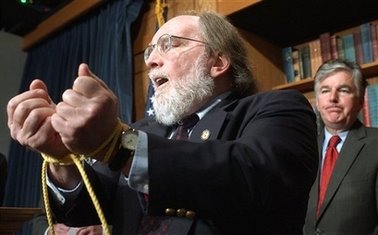
A number of House Democrats held a press conference yesterday to complain about the terms of debate for the resolution to be debated today on Iraq and the Global War on Terror. They cleverly tied their wrists with yellow ribbons to show that 'their hands are tied' (clever, see?), and that this is a false debate:
Rep. Neil Abercrombie (D-Hawaii) complained Wednesday that House leaders were not going to permit Democrats to offer amendments to the resolution, forcing them into a position of either voting against supporting the troops or for the Republican formulation of the war.
"Our hands are tied — literally — on the floor of the people's House," Abercrombie said at a news conference, his hands tied together with yellow rope to symbolize his frustration. "Do not put us through the farce and the fraud of a pseudo-debate."
House Majority Leader John A. Boehner (R-Ohio) was unsympathetic.
"That is not a 'gotcha.' They have a decision to make. That is what we get elected to do," Boehner said.
So already this is sort of amusing. Faced with charges that they are insufficiently committed to winning the War on Terror, Democrats respond by complaining that the charge is unfair, and then they tie their hands with yellow ribbon and say that they are powerless.
Smart politics! Here's another idea: try nominating a WAR HERO for President!
Moving on, the kernel of their argument is that they are being forced to either vote yes or no - with no opportunity for amendment - on this resolution:
109th CONGRESS
2d Session
H. RES. 861
Declaring that the United States will prevail in the Global War on Terror, the struggle to protect freedom from the terrorist adversary.
IN THE HOUSE OF REPRESENTATIVES
June 12, 2006
Mr. HYDE submitted the following resolution; which was referred to the Committee on International Relations, and in addition to the Committee on Armed Services, for a period to be subsequently determined by the Speaker, in each case for consideration of such provisions as fall within the jurisdiction of the committee concerned
--------------------------------------------------------------------------------
RESOLUTION
Declaring that the United States will prevail in the Global War on Terror, the struggle to protect freedom from the terrorist adversary.
Whereas the United States and its allies are engaged in a Global War on Terror, a long and demanding struggle against an adversary that is driven by hatred of American values and that is committed to imposing, by the use of terror, its repressive ideology throughout the world;
Whereas for the past two decades, terrorists have used violence in a futile attempt to intimidate the United States;
Whereas it is essential to the security of the American people and to world security that the United States, together with its allies, take the battle to the terrorists and to those who provide them assistance;
Whereas the Taliban, Al Qaeda, and other terrorists failed to stop free elections in Afghanistan and the first popularly-elected President in that nation's history has taken office;
Whereas the continued determination of Afghanistan, the United States, and the North Atlantic Treaty Organization will be required to sustain a sovereign, free, and secure Afghanistan;
Whereas the steadfast resolve of the United States and its partners since September 11, 2001, helped persuade the government of Libya to surrender its weapons of mass destruction;
Whereas by early 2003 Saddam Hussein and his criminal, Ba'athist regime in Iraq, which had supported terrorists, constituted a threat against global peace and security and was in violation of mandatory United Nations Security Council Resolutions;
Whereas the mission of the United States and its Coalition partners, having removed Saddam Hussein and his regime from power, is to establish a sovereign, free, secure, and united Iraq at peace with its neighbors;
Whereas the terrorists have declared Iraq to be the central front in their war against all who oppose their ideology;
Whereas the Iraqi people, with the help of the United States and other Coalition partners, have formed a permanent, representative government under a newly ratified constitution;
Whereas the terrorists seek to destroy the new unity government because it threatens the terrorists' aspirations for Iraq and the broader Middle East;
Whereas United States Armed Forces, in coordination with Iraqi security forces and Coalition and other friendly forces, have scored impressive victories in Iraq including finding and killing the terrorist leader Abu Musab al-Zarqawi;
Whereas Iraqi security forces are, over time, taking over from United States and Coalition forces a growing proportion of independent operations and increasingly lead the fight to secure Iraq;
Whereas the United States and Coalition servicemembers and civilians and the members of the Iraqi security forces and those assisting them who have made the ultimate sacrifice or been wounded in Iraq have done so nobly, in the cause of freedom; and
Whereas the United States and its Coalition partners will continue to support Iraq as part of the Global War on Terror: Now, therefore, be it
Resolved, That the House of Representatives--
(1) honors all those Americans who have taken an active part in the Global War on Terror, whether as first responders protecting the homeland, as servicemembers overseas, as diplomats and intelligence officers, or in other roles;
(2) honors the sacrifices of the United States Armed Forces and of partners in the Coalition, and of the Iraqis and Afghans who fight alongside them, especially those who have fallen or been wounded in the struggle, and honors as well the sacrifices of their families and of others who risk their lives to help defend freedom;
(3) declares that it is not in the national security interest of the United States to set an arbitrary date for the withdrawal or redeployment of United States Armed Forces from Iraq;
(4) declares that the United States is committed to the completion of the mission to create a sovereign, free, secure, and united Iraq;
(5) congratulates Prime Minister Nuri Al-Maliki and the Iraqi people on the courage they have shown by participating, in increasing millions, in the elections of 2005 and on the formation of the first government under Iraq's new constitution;
(6) calls upon the nations of the world to promote global peace and security by standing with the United States and other Coalition partners to support the efforts of the Iraqi and Afghan people to live in freedom; and
(7) declares that the United States will prevail in the Global War on Terror, the noble struggle to protect freedom from the terrorist adversary.
Now what is so unfair about this resolution? Either you agree with it or you don't. The Democrats complain that this resolution politicizes the debate. Are you kidding me?
This complaint comes from the same folks who went to Baghdad before the war and said they believed Saddam over President Bush. The same folks that complained that the press can't film coffins arriving from Iraq. The same people who ran to the cameras breathlessly to excoriate the President over Abu Gharib and Haditha, and who say that regardless of what the facts may ultimately show about such events, senior military officials should be punished, and Rumsfeld forced to resign. The same folks who are trying to rewrite history on the questions of WMD in Iraq.
The same people who forced this debate!
THEY are complaining that this resolution 'politicizes' the debate.
Well you know what? When you win the majority, you can write the resolution. Until then, you can have your say - 5 hours worth of debate time - and then vote 'aye' or 'nay.'
Back to the top.
House Set to Debate Iraq Today
The House will today spend 10 hours debating a resolution regarding the War on Terror. You can read the resolution here.
The Post covers the debate here, and notes that the resolution cannot be amended - simply voted up or down. Bet on 'up.' The Post piece highlights the Republican divisions on this issue, and features an amusing quote from Ray LaHood, saying it is a dumb idea to debate the resolution. No word on whether he has expressed this view to Wayne Gilchrest and several others, who joined with Democrats to force this debate.
And while the Democrats forced this debate in the hope of political gain, it looks like they may wind up more divided than the GOP (next post).
Back to the top.
Democratic Fissures Showing
The Hill notes that on the eve of the House debate today over Iraq, a Democratic caucus meeting turned into a 'circus,' over Iraq. 'Leaders' of the 'Out of Iraq Caucus' berated Minority Leader Pelosi over her failure to lead more aggressively on troop withdrawl. Others are criticizing Pelosi for 'poor political judgment' in not preventing her ally John Murtha from announcing a planned challenge to Steny Hoyer.
Republicans could not have hoped that an opposition with such wind at their backs could become so divided so quickly, without any major shift in the electoral terrain. Republicans have had some successes lately, no doubt - Zarqawi, the economy, improved polls, a special election win in California - but nothing to explain how House Democrats have fallen apart over Iraq, Jefferson, the Murtha leadership bid, and probably immigration, before too long.
If you're a Republican, read the whole piece:
Anti-war Dems blast Pelosi over endgame
By Josephine Hearn
A series of recent internal disputes have sown discontent in some quarters of the House Democratic caucus, threatening to disrupt the unified front Democrats have used to frustrate Republicans in the 109th Congress.
Despite a superior position in the polls and impressive unity on key votes, House Democrats have been feuding in recent weeks over such issues as the seat of Rep. William Jefferson (D-La.) on the Ways and Means Committee, the ambitions of two of their most respected members to be majority leader in a Democratic House and their long-standing lack of consensus on whether to redeploy troops out of Iraq.
Such tensions were in full display yesterday morning at a caucus meeting on Iraq where three members of the Out of Iraq Caucus clustered around a microphone to berate House Minority Leader Nancy Pelosi (D-Calif.) loudly for failing to take a stronger stand on leaving Iraq.
At times having to speak above her colleagues, one member of the caucus, Rep. Maxine Waters (D-Calif.), told Pelosi that the Out of Iraq Caucus members have been “leaders on this issue,” according to several attendees, and that they deserve to play a more prominent role in the House’s planned debate of Iraq policy today.
“We’re all leaders,” Pelosi replied.
Several Democrats came to Pelosi’s defense. Rep. Anna Eshoo (Calif.) attempted to quiet the increasingly unsettled crowd, while Rep. George Miller (Calif.) approached a handful of Out of Iraq Caucus members, most notably Reps. Lynn Woolsey (Calif.), Barbara Lee (Calif.) and Jerrold Nadler (N.Y.), and engaged in a “heated conversation,” one witness said.
“The whole thing was a circus,” a Democratic aide said. “The reaction of most people was to leave.”
...Caught unawares by Murtha’s challenge, Hoyer spent five days shoring up support and had contacted nearly all of his colleagues before Murtha called it off. While some members were elated to see Hoyer challenged, many others, perhaps a majority of the caucus, saw the race as ill-timed and felt Hoyer had done well by them as whip and political leader.
Some were upset that Pelosi had not deterred Murtha from launching the bid and had remained silent on the race for days after it had begun.
“The fact that she said nothing about it for so long and that she allowed him to go through with it in the first place, it shows terrible political judgment,” one House Democrat said.
Pelosi spokeswoman Jennifer Crider said, “The House Democrats are unified, organized and disciplined. They’re keeping their focus on winning the House in 2006. Unlike the Republicans, the Democratic Caucus promotes diversity of ideas, and they come from the bottom up, unlike the top-down, rubber-stamp approach that Republicans use.”
The Jefferson dispute exposed fissures between Democratic leaders and many members of the Congressional Black Caucus. Democrats are expected to vote today to remove him temporarily from Ways and Means.
Back to the top.
Wednesday, June 14, 2006
Kos Getting 'Pragmatic?'
Apparently since the Kos crowd backed Jim Webb for the Senate in Virginia, and Mark Warner for President, they are congratulating themselves for their 'pragmatism.' Do you think that Joe Lieberman appreciates their openness toward conservative Democrats?
I know what the Left will answer: pragmatism means supporting more conservative candidates in more conservative states, not just supporting conservatives. Still, they are showing a lot of love to two newcomers, and throwing old reliable under the bus. That's not very pragmatic. The money it will take to KEEP the Connecticut Senate seat Democratic could probably be spent a lot better against Jim Talent, Conrad Burns, Jon Kyl, Rick Santorum, or several other Republicans.
Is this pragmatism with a grudge?
Back to the top.
Lieberman Lead Slipping Further?
According to Political Wire, Lieberman leads Lamont by just 6 points. I'm not sure the source of the Rasmussen number, but I believe that this is a poll among all Democrats. As before, that would probably tend to overstate the lead for Lieberman, and shows why he is preparing for an Independent bid.
Frankly, I'm very skeptical of this poll. If it is accurate, then the lead of a popular, 3-term incumbent who is nationally recognized and well-known, has evaporated to virtually nothing in a matter of weeks - without any significant advertising so far. (Anyone in Connecticut, please correct me if I'm wrong about the advertising.) Political careers don't shatter like this without a major event causing it.
That said, there's little doubt that Lieberman is in a real race for renomination, and Lamont's folks have to like their chances right about now.
Back to the top.

Sometimes They Write Themselves...
Congressman Henry Waxman, would-be Chairman of the House Government Reform Committee, should the Democrats retake the House majority, has a gift for timing. He conducted an interview with National Journal (subscription required), in which he talked about the bipartisan manner of leadership he would bring to the Government Reform Committee if he became Chairman, and lamented the 'partisan witch hunts' that the Committee is known for:
GOVERNMENT OPERATIONS
Waxman Says He Would Lead Panel In Bipartisan Manner
House Government Reform ranking member Henry Waxman, D-Calif., the outspoken 16-term lawmaker whose passion for oversight has been directed at corporate giants in the auto and tobacco industries, is quietly laying the groundwork for chairing the watchdog committee if Democrats win back the majority in November.
"If I became chairman I would focus on two things. One, that I maintained a good working relationship with [Government Reform Chairman Davis], and two, that I would take a more vigorous approach in areas where taxpayer dollars have dissipated," Waxman said in an interview with CongressDaily. "I wouldn't disappoint myself if I were chairman," he said with a smile.
Waxman, who joined the Government Reform Committee just after his party was thrown into the minority in 1994, would also focus on a host of other issues that he says are lacking congressional oversight. In a quick response that suggested he had considered the prospect of taking over the committee, he rattled off as top priorities congressional investigations into the prison abuse scandals at Abu Ghraib; the intelligence used by the White House to justify going to war in Iraq; no-bid contracts for reconstruction efforts in Iraq, Afghanistan and the hurricane-ravaged Gulf Coast, and evaluating how GOP-sponsored legislation in the House undermines state authority.
Waxman released a study on the state pre-emption issue last week, but said he did not lobby for the full committee to take it up because "I didn't want to put Chairman Davis on the spot ... and I didn't think he'd want to" push the topic himself.
The bipartisan approach to oversight that Waxman imagines would be vastly different than in the days when Rep. Dan Burton, R-Ind., was at the helm during the Clinton administration -- the last time the House and White House were controlled by opposite parties. Burton led a series of contentious hearings looking into the Clinton administration's campaign finance practices, an investigation that Waxman once called "a partisan witch hunt," according to the Almanac of American Politics.
But in today's embittered political climate, widely considered more partisan that ever, Waxman admits it would be difficult to make friends on the other side of the aisle while conducting his own investigations. "A lot of our legislation will not move very far," he said, noting that even if Democrats win back the House in November, their chances in the Senate are less optimistic.
Waxman also voiced a longing for the return of "a real deliberative process" over legislation at the committee level and bemoaned the increasing use of suspension of the rules to pass bills. The result, he said is that "the expertise of members on both sides of the aisle have become less important."
The lawmaker points to the pending overhaul of the U.S. Postal Service overhaul bill as an example of substantive legislation handled in a bipartisan manner. The legislation, awaiting conference, stands to revamp the postal service for the first time in 30 years, changing how the agency raises rates and operates its pension plans. The ranking member said discussions have been free from partisan bickering because, "I think Chairman Davis decided he wanted to make it that way."
By Jessica Brady
What else happened yesterday? Well, someone named Henry Waxman - obviously not the same 'bipartisan' Henry Waxman - asked Government Reform Committee Chairman Tom Davis to convene hearings into Karl Rove, and his conduct with regard to the leaking of the identity of Valerie Plame.
Could he not even wait a day?
Back to the top.
Mollohan Explains 9,000 Percent Gain
Roll Call (subscription required) reports that Alan Mollohan had a good year in real estate in 2005, after a property he owned gained 9,000 percent in value in a 4-year span. Oh - and he didn't report it properly the first time around.
The article also notes that Mollohan secured an earmark for a bankrupt business partner, whose firm reportedly did little work for the money.
This explanation from Mollohan will not satisfy anyone, and will only send people scurrying to dig up more info on what other Mollohan friends and partners were recipients of earmarks. Indeed, even on the Left, this explanation is greeted with skepticism. Recall too, that the FBI is still investigating this. Mollohan is in serious trouble.
It's almost comical that Nancy Pelosi has only just announced an end to the Democratic focus on the 'Culture of Corruption.' The timing is fortuitous, since it could not survive in the face of the behavior of Bill Jefferson, Alan Mollohan, Cynthia McKinney, and a passel of others:
Mollohan Made $1M-Plus in Real Estate in 2005
June 14, 2006
By John Bresnahan,
Roll Call Staff
Rep. Alan Mollohan (D-W.Va.) made more than $1 million in 2005 alone from real estate investments, and the value of Mollohan’s stock in a Washington, D.C., condominium building that he, his wife and his cousin owned increased by more than 9,000 percent in value between 1999 and 2003, according to documents released by the West Virginia Democrat on Tuesday.
Mollohan also acknowledged that after a “comprehensive review” of his financial disclosure statements from 1996 to today, he would have to file amended reports covering the five-year period from 1999 to 2004 due to “a relative handful of unintentional and immaterial mistakes” included in those filings.
But Mollohan claimed that a lengthy examination of his financial dealings during the last decade exonerated him of charges made in February by the National Legal and Policy Center, a conservative watchdog group. The NLPC has alleged that Mollohan was trying to disguise the dramatic increase in his personal wealth during the last several years by failing to disclose or misrepresenting the true value of his assets.
...Mollohan released his 2005 financial disclosure report on Tuesday, a day before it was required to be publicly unveiled, along with an extensive analysis of his real-estate transactions from 1996 to 2005.
Mollohan said he would be filing amended financial disclosure statements for 1999 to 2004, due to small, “inadvertent errors” in the reports he submitted to the House ethics committee for that period.
Mollohan, however, rejected any suggestion that there were “sinister motives” behind those errors, and he blasted the NLPC for its attacks on him.
“The documents prove that the National Legal and Policy Center has wildly exaggerated the inadvertent errors on my past financial disclosure statements,” Mollohan said in a statement released by his office. “They also show that NLPC is dead wrong in implying that I improperly benefited from my office.”
...Ken Boehm, chairman of NLPC, said that Mollohan’s latest document release did not satisfy his group’s concerns. “It begins to show we were correct all along,” said Boehm of the fact that Mollohan had to file amended disclosure reports. “And the unanswered questions are the same as they have been all along — what is the relationship between his earmarks and his personal finances.”
Overall, Mollohan’s reported personal assets for 2005 were worth at least $8 million, and he reported liabilities in excess $3.43 million, according to his latest financial disclosure statement.
In 2000, Mollohan’s assets were worth a minimum of $179,000 and his liabilities totaled at least $170,000.
...Mollohan also released a “Chronology of Real Estate Transactions” from 1999 to 2005 that provides far more detail than was previously available.
In that document, Mollohan said he and his wife, Barbara, as well as his third cousin Joseph Jarvis and Jarvis’ wife, formed a company called Remington Group LLC in 1996. The four co-owners contributed a combined $50,000 to start the company.
Jarvis had previously worked in real estate, but he ended up filing for bankruptcy in 1994, according to the Knight/Ridder Tribune News Service. A company owned by Jarvis received a $1 million earmark in 1995 thanks to Mollohan to develop software to help decommission Energy Department nuclear sites, and subcontracted most of that work out since it lacked the technical expertise to execute the contract.
Remington Group was formed to buy 17 renal units in The Remington, an apartment building in downtown Washington, D.C. Instead, the Remington Group bought the stock of Remington Inc., the company that actually owned the units. The Remington Group secured a $1.5 million mortgage to cover the purchase.
Over the next several years, the Remington Group and Remington Inc. purchased seven more units in the same building, including three owned by the Mollohans. In 1999, Remington Group and Remington Inc., were merged into one company, named Remington, Inc. The company secured a $2.3 million bank loan, and then bought an additional unit.
In 2001, Mollohan inherited interest in a West Virginia company that owned hotel property and a farm from his father, the late Rep. Robert Mollohan (D-W.Va.). Alan Mollohan has stated the he received a “sizable inheritance” from his father’s estate.
Late in 2002, the Mollohans began investing in the North Carolina beachfront property with Laura and Donald Kuhns. Altogether, the Mollohans and Kuhns have jointly purchased five lots in Bald Head Island, N.C.
The Mollohan’s vacation home fetches nearly $9,000 per week in rental fees during peak summer season. The couple is now selling the home and asking for $3.7 million, according to recent media reports.
The Mollohans claim a minimum value on all five Bald Head Island properties of more than $3.1 million. They also have mortgages on the properties of at least $2.2 million.
By October 2003, the Mollohans were benefiting from a scorching real-estate market in Washington, D.C., and refinanced their half interest in Remington Inc., for $4.1 million, according to the West Virginia Democrat’s documents. The company had purchased more units in the downtown building, giving it 26 in total, and both the Mollohans and the Jarvises received nearly $762,000 from the company at that time.
In addition, throughout 2003 and 2004, the Mollohans bought additional properties in Canaan Valley, W.Va. Remington Inc., bought its 27th rental unit.
In 2004, with real estate markets still strong, the Mollohans were able to refinance some of their properties. They also “withdrew equity” in those properties worth more nearly $232,000.
In 2005, additional refinancings of the North Carolina and Washington properties allowed them to withdraw another $1.01 million in equity. The couple is carrying a $4.975 million mortgage on their half of Remington Inc.
According to an accountant retained by Mollohan, and whose report the Congressman released Tuesday, the average value of each unit owned by Remington increased from nearly $108,000 to $275,000 from 1999 to 2003.
This boosted the value of the Mollohan’s stake in the corporation worth from a negative $38,000 in 1999 to nearly $3.6 million in 2003 — an increase of 9,438 percent over a four-year period.
Overall, the Mollohans have been able to take nearly $2 million in equity from their real estate holding over the last decade while still seeing those assets increase in value.
In addition, a recent Wall Street Journal article also highlighted the relationship between Mollohan and the CEO of FMW, Dale McBride, whom Mollohan has described as a life-long friend.
Mollohan and McBride purchased a 300-acre farm together in West Virginia in May 2005. In December 2005, FMW won a $2.1 million NASA contract from a program funded through a Mollohan earmark.
Back to the top.
An Improved GOP Mood
Roll Call (subscription required) reports today something that's been in the wind the last week or so: improved prospects for Congressional Republicans:
Good Run Buoys GOP
June 14, 2006
By Ben Pershing and Erin P. Billings,
Roll Call Staff
After months of negative headlines and dismal poll numbers, House and Senate Republicans are taking the past two weeks’ run of good news as evidence that the party’s political fortunes may be on the rebound.
Last week’s assassination of Iraqi terrorist leader Abu Musab al-Zarqawi, the solidification of the Iraqi government, the GOP’s open-seat victory in California’s 50th district and Tuesday’s news that White House adviser Karl Rove will likely not be indicted in the CIA leak probe have combined to fuel a sense of cautious optimism among Republican Members and aides.
“It’s like a camel hitting an oasis,” said Senate GOP Conference Chairman Rick Santorum (Pa.). “It’s nice to get some water.”
Sen. Sam Brownback (Kan.) said Republicans certainly feel that “things are improving,” and said it appears that the majority is starting to move beyond its low point.
“We’ve been in a rough patch for a while,” Brownback acknowledged. “For months, it just didn’t seem like anything we’d try was working. Momentum has shifted.”
On the House side, a veteran lawmaker said of his fellow Republicans, “They’re calmer. You can see it.”
As he has repeated tirelessly, National Republican Congressional Committee Chairman Tom Reynolds (N.Y.) emphasized that the victory in California showed that individual races would be won in November on local issues rather than national trends.
But Reynolds did add that the best way for Republican lawmakers to regain confidence about their standing across the country would be for President Bush’s numbers to rebound, something Reynolds believes is slowly starting to happen.
“This is the best news the president has had in months,” Reynolds said.
If Republicans are actually in the midst of righting their ship, then the polls haven’t yet detected a significant shift. But the most recent public survey does contain some hopeful news for the GOP.
A USA Today/Gallup poll taken June 9-11 — after al-Zarqawi’s death — and released Tuesday showed that Bush’s approval rating had crept up to 38 percent, his best showing since February.
The percentage of respondents saying the Iraq war was a mistake dropped 6 percent since April (from 57 percent to 51 percent), while the percentage who believe the U.S. can win the war rose from 60 percent in April to 69 percent in the new survey.
...But Democrats cautioned that the GOP shouldn’t get too excited about their recent good fortune.
“Two good days doesn’t make up for nine months of President Bush polling around 40,” said Jennifer Crider, spokeswoman for House Minority Leader Nancy Pelosi (D-Calif.).
Jim Manley, spokesman for Senate Minority Leader Harry Reid (D-Nev.), said: “Republicans are desperate to glom onto any good news.”
Manley argued that the GOP has lost far too much ground already to turn things around, contending that Republicans are no longer credible on the very issues they hope to use against the Democrats this fall.
...Immigration looms as an issue that has prompted significant disagreement within the party, and public finger-pointing could result if the House and Senate can’t send a compromise bill to Bush’s desk before the election. House Majority Leader John Boehner (R-Ohio) said Tuesday that it would be difficult to complete a bill this year if it wasn’t done before the August recess.
...On the ethics front, Tuesday’s news about Rove was particularly welcome, House and Senate Republican sources said, since he is such an influential and well-known Republican. If he’d been indicted, the case could have given Democrats additional fodder for their anti-corruption campaign.
But those sources also noted that Republicans are crossing their fingers that no other indictments of top GOP lawmakers will be handed down in coming months — and that Democrats continue to produce their own share of corruption headlines. Republicans privately remain worried that several Members could face indictment charges related to former lobbyist Jack Abramoff and other scandals.
...Several top aides said the GOP Conference knows it must continue to highlight differences between the two parties as the months progress, including policy divides over the war, fiscal discipline and social matters — all issues that rally core Republican voters and point out fractures among Democrats.
“There is a choice in this,” said one senior Republican Senate staffer. “If this election is about a choice, it helps us. The best thing we have going for us is the Democrats. If we can define them, we can make it a choice about us.”
Back to the top.
Subscribe to:
Posts (Atom)

